Climate
Dignity encompasses the idea that all people have the right
to live in a world where their health, freedom, and livelihoods
are not threatened
by climate change. In the spirit of climate justice, this applies especially to those
individuals, communities,
and countries most affected or likely to be affected
by climate change, who are thus in particular need of protection. At
the same
time, Climate Dignity emphasizes that the consequences of human-induced
climate change and the associated loss
of biodiversity not only threaten human
dignity but also endanger nature. The concept underlying Climate Dignity places
the
more-than-human relationships at its core, highlighting the interdependence
of humans and nature: to violate the dignity
of nature is to harm human dignity.
This group exhibition at the Kuenstlerhaus Vienna frames Climate Dignity as
a call to action.
The research conducted by participating artists and the resulting works aim to equip us
all with knowledge
and courage to resist the ongoing destruction of our world.
The following artists and collectives are represented
and also teach and/or conduct research at the University of Applied Arts Vienna: Andreas Duscha, Ernst Logar, Shaken Grounds,
Christoph Höschele.
“The geo-philosopher moves along the crest of turbulence,
on the shoulders of waves that envelop mind, energy, and matter,
and that diffuse them into the atmosphere.” (Gilles Deleuze,
1993)
Even before the Anthropocene, disruptive geological forces were compelling artists
to reflect on the fragility
of existence and the origins of their age. Such events raised
fundamental questions about where to ground reason when the
conditions of life could
shift so radically. Natural disasters—like the earthquakes and volcanic eruptions in southern Italy
—have
long served as focal points for both scientific inquiry and artistic reflection.
According to the myth of Rome's
founding, Aeneas entered the underworld through
the trembling Phlegraean Fields—surrounded now by Europe’s largest illegal
toxic dump—
to seek guidance on where to settle after his long journey.
On the other hand, the major eruption of Mount
Vesuvius in 79 CE was associated with
the sudden threats posed by the Iron Age, a period marked by austerity and wars
that
prompted a range of artistic responses.
Today, areas prone to seismic activity are
influencing artistic research
and expression in a different way. While such places once
connected people to a poly-temporal world view, they now bear the
weight of new,
man-made pressures. Global warming, groundwater extraction, resource mining,
clean energy technologies, and
waste disposal are all increasing the strain on the Earth’s crust,
resulting in human-accelerated earthquakes. This almost
incomprehensible, yet undeniable
phenomenon highlights the complexity of the ecological crisis, revealing disturbing
new
entanglements between humanity and the environment.
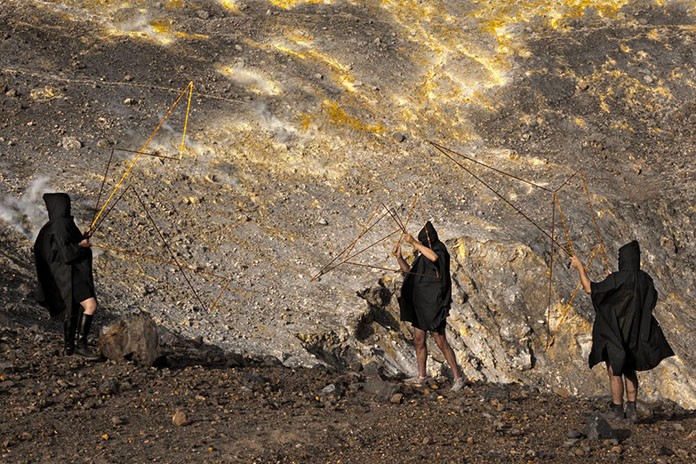
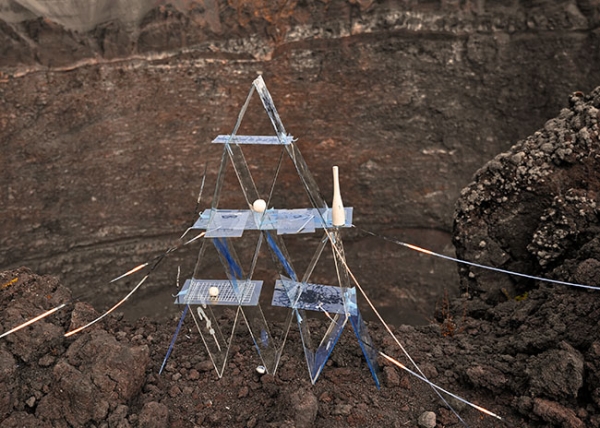
The artist collective Shaken Grounds revisits the continental
margins of southern Italy,
exploring the intersections of natural seismic activity and anthropogenic environmental damage
through an interwoven mesh of artistic experiments. They recognize that the trembling of the earth,
once regarded as one
of Gaia’s natural forces, is now being driven by human interference as well.
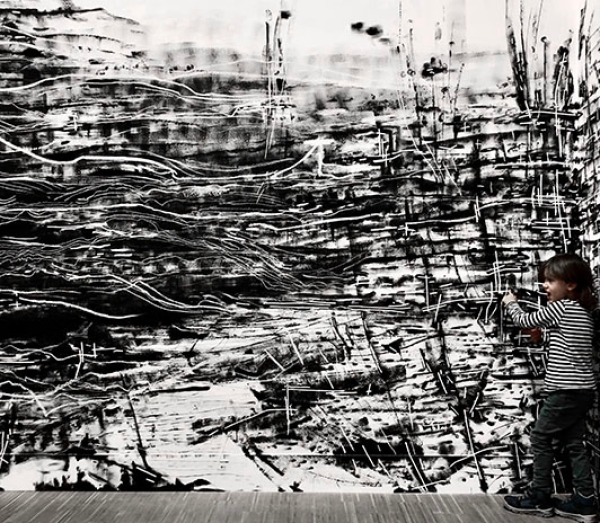
Art, as research and practice, excels in detecting
and expressing the changing relationship
between humanity and our evolving, technologically influenced, and highly damaged
geological environment.
On April 11, 2025, 16:00–19:00 a mini symposium with short lectures, performance,
and
audience discussion on the recording of geological, social, and psychological tremors with
Arno Böhler (philosopher), Daniel
Brandlechner (literary scholar), Nikolaus Gansterer (artist),
Mariella Greil (choreographer and dancer), Victor Jaschke (filmmaker),
Peter Kozek (artist), and Lucie Strecker (artist) takes place.
Shaken Grounds is funded by PEEK program of the
Austrian Science Fund Austria.
The exhibtion IMAGINE CLIMATE DIGNITY
is Co-curated by Barbara Hoeller and Simon
Mraz.
A joint project of the Section for International Cultural Affairs in the Ministry
of Foreign Affairs, the Austrian
Cultural Forums, and the Kuenstlerhaus Association.
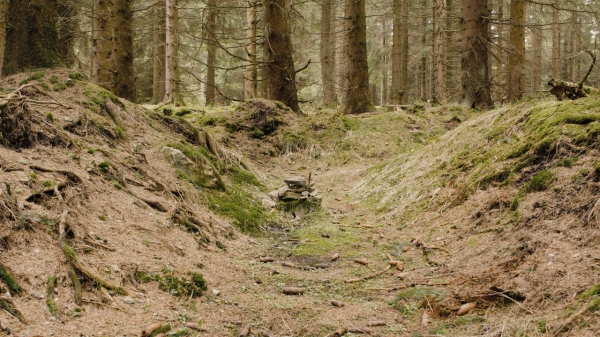
Christoph Höschele’s work is an experimental exploration of
the catchment area of the Bílina River in Northern Bohemia. He went on multi-day trips in the area to examine nature and visible
human impact on it using film.
He used the collected material to create a large-format video piece that, in a no-comments
style, shows the manifestations of the Bílina from source to delta.
See all participating artists at
imagineclimatedignity.at/en/about