The
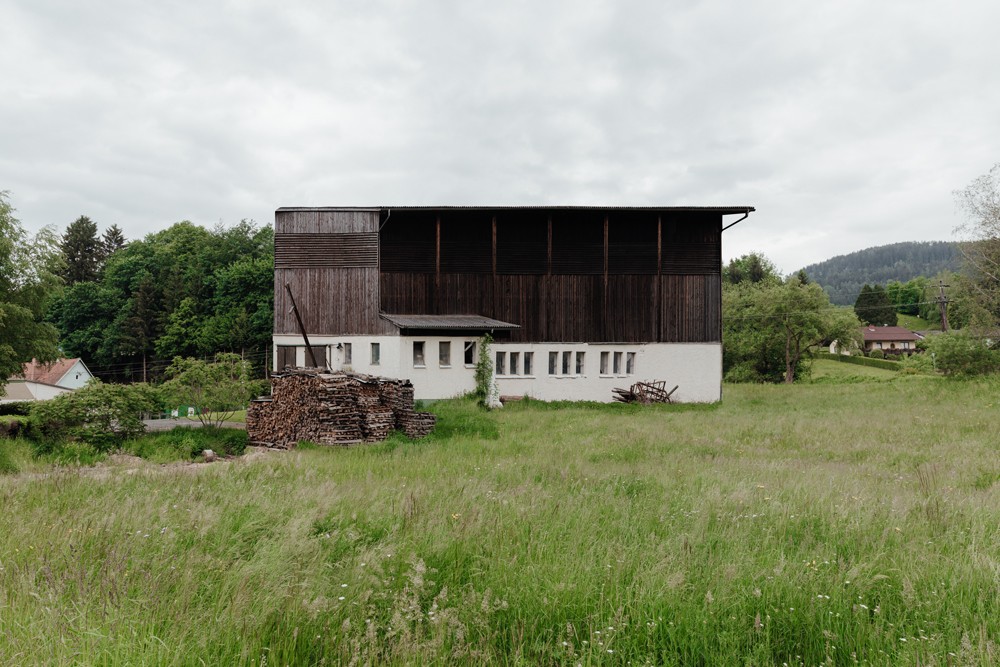
series “Stall” began in 2020 as a factual, photo-documentary archive of traditional barn structures in Upper Styria and has
been ongoing ever since. The conceptual approach lies in capturing rural architecture in its clarity and functionality, and
subsequently transforming it through manual image editing in Photoshop. Each photograph is taken with exactly the same composition
and framing in order to maintain documentary precision. Perspective distortions are deliberately avoided so that the form
and structure of the buildings remain visible in their purest, most functional state. Over time, the project expanded to include
barns from other regions closely connected to the biographies of Brenner–Havelka–Plessl: Prad am Stilfserjoch (Trentino-South
Tyrol, Italy), Brno (Moravia, Czech Republic), and the Murtal (Upper Styria, Austria). This results in a personal, geographically
rooted atlas of rural architecture in Central Europe. The project is realized in collaboration with photographer Daniel Kindler,
whose images serve as the foundation for the subsequent
visual processing.
The editing
of the photographs goes far beyond simple technical correction. It is a conscious, manual intervention – an old-fashioned
act of design, in which the forms of the barns are digitally altered by hand. This process stands in contrast to the common
use of artificial intelligence (AI) in contemporary image editing, which could easily automate such tasks. By insisting on
manual manipulation, the human creative act remains at the center of the work. The editing process points to the relationship
between humans and their environment – much like the physical, non-automated labor on farms, where each step is determined
by human effort. The exhibition very unintelligent work references the tradition of New Objectivity and
introduces, for the first time, the term Austrian Objectivity – an approach focused on presenting things in their own “simplicity”
and “beauty.” At the same time, the concept of objectivity is critically examined: through exaggerated reduction and forced
uniformity, it is driven to absurdity – until, in the end, all that remains is a box.
Max Brenner uses
the constant stream of images and information produced in various forms by our society as his primary source of inspiration
and channels this into the starting point for his works.
Nick Havelka is a painter, printmaker
and sculptor who conveys deeply personal insights in his paintings, sketches, and drawings.
Michael
Plessl focuses on the possibility of reint erpreting an idea in its most concrete and pure form, in transforming
it into the smallest form of comprehensible communication. Michael is an alumnus of the Department of Site-Specific Art at
the University of Applied Arts Vienna. The decisions presented here are based on a clearly structured concept developed in
close collaboration with the photographer Daniel Kindler.
Daniel Kindler’s photographic work forms
the essential visual foundation for the project and serves as the basis for further artistic processing. His involvement ensures
a coherent connection between the documentary origin of the images and their subsequent conceptual transformation.
Together
with Brenner-Havelka-Plessl, Kindler shapes the project’s visual and conceptual identity, making this collaboration a core
element of the work.