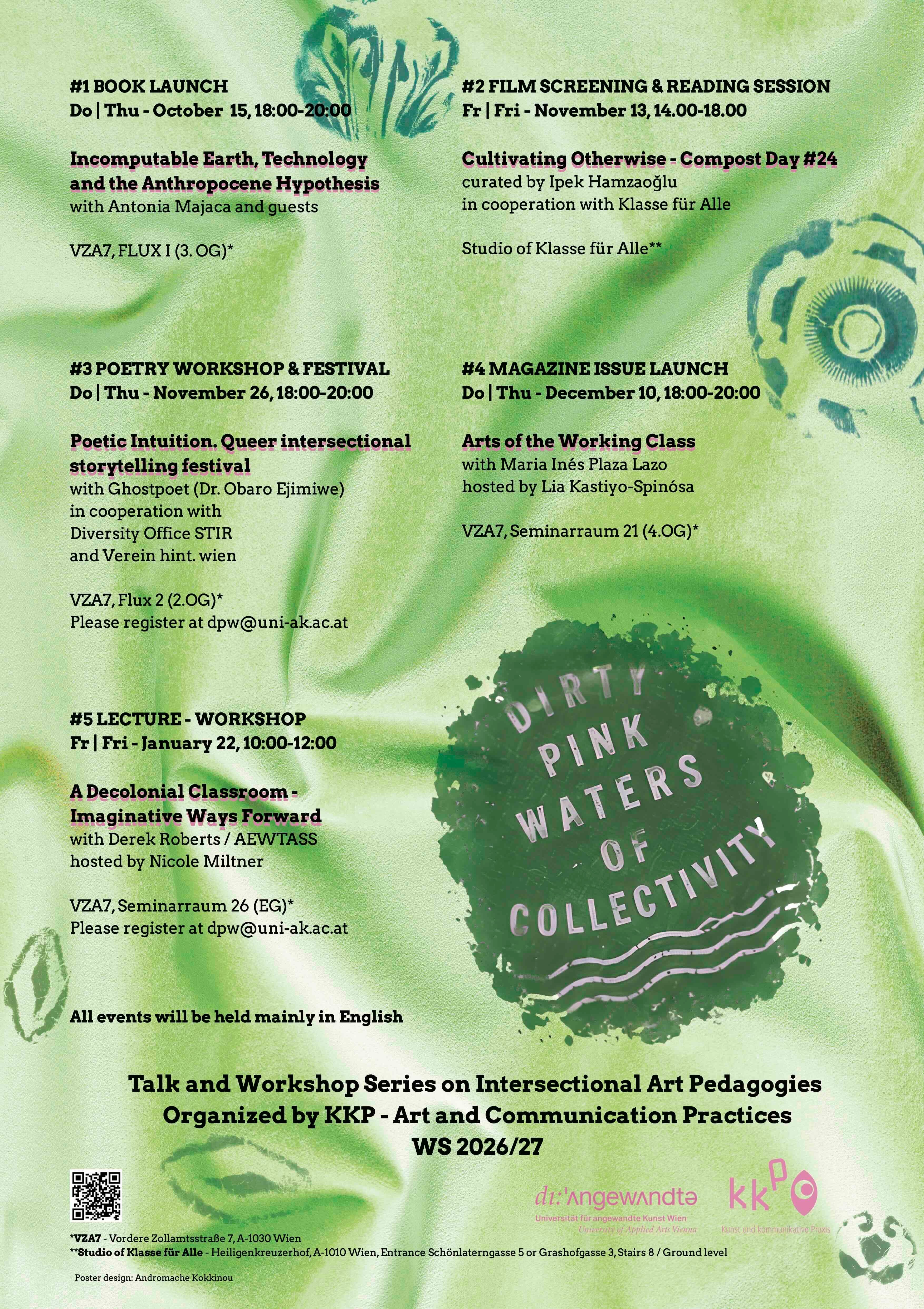
Save the Dates WS 2026/27
#1 Book Launch
Incomputable Earth, Technology and the Anthropocene Hypothesis
with Antonia Majaca, Monika
Halkort & guests
#2 Film Screening & Reading Session
Cultivating Otherwise – Compost Day #24
curated
by Ipek Hamzaoğlu, in cooperation with Klasse für Alle
#3 Poetry Workshop & Festival
Poetic Intuition
– Queer intersectional storytelling festival
with Ghostpoet (Dr. Obaro Ejimiwe), in cooperation with Diversity Office
STIR and Verein hint. wien
#4 Magazine Issue Launch
Arts of the Working Class
with Maria Inés Plaza Lazo,
hosted by Lia Kastiyo- Spinosa
#5 Lecture-Workshop
A Decolonial Classroom – Imaginative Ways Forward
with
Derek Roberts / AEWTASS, hosted by Nicole MiltnerMore
information
#1 Book LaunchIncomputable Earth, Technology and the Anthropocene Hypothesiswith Antonia Majaca, Monika Halkort & guests
15 October 2026
18:00 – 20:00
VZA7,
3. OG, FLUX I
The event will be held in English
Incomputable Earth: Technology and the Anthropocene
Hypothesis challenges the dominant narrative that positions technological solutions as the primary response to ecological
crisis. This open access collection argues that climate breakdown represents an irreducibly incomputable problem that cannot
be resolved through algorithmic optimization or cybernetic planetary management. Radically interrogating the political epistemology
underlying the Anthropocene hypothesis against the backdrop of new regimes of algorithmic classification and prediction, this
volume addresses the crucial need to rethink the meaning and inter-relationality of “human,” “nature,” and “technology.” Drawing
on feminist science studies, decolonial epistemologies, and historical materialist analysis, the contributors examine how
computational frameworks transform Earth’s complex relationships into extractable data, perpetuating the very logics that
created planetary crisis.
Antonia Majaca is a Research Fellow in the Department of Philosophy
and Cultural Heritage at Ca‘ Foscari University of Venice, Italy, where her research within the ERC-funded HealthXCross project
examines microbiome technoscience through decolonial feminist and historical materialist analysis
Monika
Halkort is an assistant professor and head of the School for Transformation at Angewandte in Vienna. Her current
research focuses on political ecologies of transformation, emphasizing the material entanglements of extractivism, circularity
and just transition discourses in post-mining societies.